
Rubber Parts Manufacturing – Durable, Elastic, and Versatile Solutions for Modern Industry
Rubber parts manufacturing is critically important for many industrial sectors, as rubber offers properties that metal or plastic cannot provide. It is elastic, abrasion-resistant, absorbs vibration, provides hermetic sealing, and can be produced according to very specific parameters. Thanks to these characteristics, rubber components are widely used in agriculture, the automotive and heavy machinery sectors, the chemical industry, food production, pharmaceutical systems, hydraulics, pneumatics, and many other fields.
Companies that specialize in rubber hoses often also manufacture various rubber components, as they are essential for hose connections, sealing systems, and technical equipment.
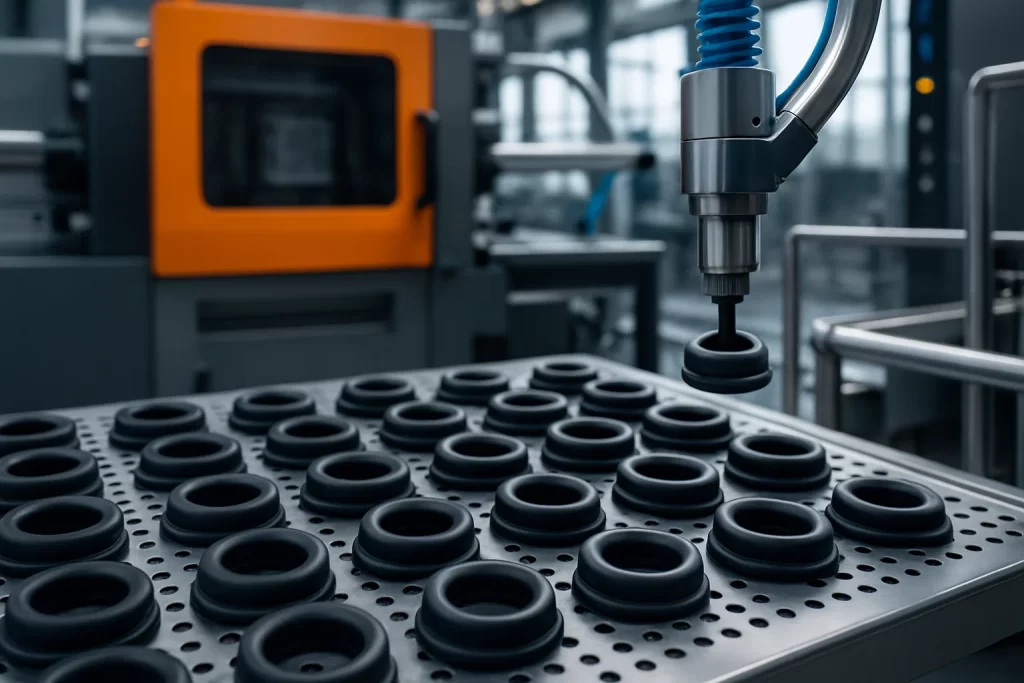
Properties of Rubber Parts
Rubber parts are manufactured from natural or synthetic rubber (EPDM, NBR, SBR, silicone, Viton, etc.), selected according to operating conditions. Each rubber type has unique properties, allowing components to be adapted to highly specific environments.
Key properties of rubber parts:
High elasticity – rubber fully recovers after deformation.
Resistance to abrasion and wear – ideal for intensively moving systems.
Chemical resistance – certain rubber types are resistant to oils, fuels, acids, alkalis, and solvents.
Vibration and shock damping – rubber elements effectively protect equipment from damage.
Temperature resistance – depending on the compound, rubber can operate from –50 °C up to +200 °C.
Hermetic sealing – excellent sealing performance, ideal for gaskets and seals.
Rubber parts can be soft, hard, porous, reinforced, bonded, or molded according to specific technical requirements.
Rubber Parts Manufacturing Processes
Rubber parts can be produced using different methods depending on complexity and application:
Compression molding – suitable for larger and thicker components.
Injection molding – allows precise reproduction of complex shapes.
Extrusion – used to form profiles, strips, and long components.
Rubber-to-metal bonding – parts that require both strength and vibration damping.
Cutting and stamping – for simpler shapes made from rubber sheets.
These methods enable both single-piece and mass production.
Applications of Rubber Parts
Rubber parts are used wherever sealing, cushioning, or resistance to aggressive conditions is required:
Gaskets and seals for hydraulics, pneumatic systems, and industrial equipment
Hose connection components – protective sleeves, couplings, holders
Shock-absorbing components – vibration dampers, rubber-to-metal parts
Rubber profiles for construction, industry, and machinery
Protective coatings against impacts, abrasion, and chemical damage
Automotive and agricultural machinery parts – mounts, gaskets, bushings, protective elements
Food and pharmaceutical systems (special food-grade rubber)
Due to their high resistance and durability, rubber parts are essential in any technical system where reliability and safety are critical.
Why Choose Professional Rubber Parts Manufacturing?
Precision and custom solutions – parts manufactured according to drawings or 3D models.
High quality – suitable rubber compounds selected for specific operating conditions.
Durability – components retain their properties even in demanding environments.
Fast production – suitable for both small and large production volumes.
Versatility – rubber is suitable for virtually all industrial sectors.
Rubber parts manufacturing is a fundamental part of modern engineering. High-quality components ensure smooth equipment operation, protection against damage, and long-term system durability. If you wish, I can also prepare content about molded rubber, rubber profiles, or a full category description.